
Introduction to Option contracts – Quant Finance
12 February 2022Options are a particular type of financial instruments generally referred to as derivatives, since they derive their value (that is, their price) from an underlying security.
In this post we are going to see in a conceptual form the features of these financial products that have led to their pivotal role in financial markets.
Type of options: Calls and Puts
The most common type options are plain vanilla Call and Put options. Let us first start by their definitions.
- A Call option is a contract which gives the holder the right to buy a given amount of a security at a given price on or before a fixed specif date.
- A Put option is a contract which gives the holder the right to sell a given amount of a security at a given price on or before a fixed specif date.
Before entering more in detail, there is some common nomenclature between the two contracts that can be already be fixed here.
- The security involved in an option contract is called the underlying security. For example, this can be a stock.
- The fixed price at which the underlying can be bought or sold is called the strike or the exercise price.
- The fixed date at which the option can be exercised is called the expiration or the maturity date.
- If the underlying is bought (in case of a Call) or sold (in case of a Put) at the strike price on or before the maturity date, then we say that the option is exercised.
In particular, when the option is negotiated, the investor that buys the option is simply the buyer, or the holder of the option, whereas the counterparty investor that sells the option is referred to as the writer (that is, writing an option means selling it).
Also, the option buyer is said to be long the option (it has a long position). The option writer is said to be short the option (it has a short position).
European and American options
When we say that the option can be exercised on or before the maturity date is because this is another feature of these contracts. In particular:
- An European option allows the option buyer to exercise the right of buying/selling the underlying only on the maturity date.
- An American option allows the option buyer to exercise the right of buying/selling the underlying any time during the life of the option.
Note that these names do not really have a geographical meaning. European options are traded in America and American options are traded in Europe as well.
Let us now enter more in detail. We start by the Call options.
Call options
The word right in the definition of a Call option is important. It emphasishes that the buyer of the option has bought an 'option' and not an obligation.
In particular, it means that the holder of the Call will exercise the option only if this leads to a profit (he will buy the underlying). If this happens, then the writer of the option will have the obligation to sell the underlying at the strike price.
Then, when to buy and exercise a Call option?
If we buy a Call option is because we expect the price of the underlying going up and becoming larger than the strike. Consider tha case of a European Call option with maturity $T$.
Suppose that the underlying price is $S_0 = \$100$ and the strike is $K = \$105$.
- If at maturity, the underlying price becomes, e.g., $S_T = \$110$, the buyer will exercise the option as he could then buy the stock for a price $K=\$105$ even if its market value is $\$110$. In this case, the option writer has the obligation to sell the underlying to the buyer. The result is a profit for the buyer and a loss for the writer (since he must sold for $\$105$ a stock worth $\$110$).
- On the other hand, imagine that the underlying price does not reach the strike price. In this case, the buyer will not exercise the option which is then likely to expire worthless for him. The result is a loss for the buyer and a profit for the writer.
Call option payoff
We deduce that the payoff of the Call option depends on the difference between $S_T$ and $K$ in this way: $$ \text{Call Payoff} = \max(S_T - K, 0). $$
Furthermore, from second case 2. we deduce an important (though obvious) thing.
Buying a Call option (an option, in general) is not for free. The option buyer pays a price to the option writer. The price (or, premium) paid will be the current market value of the option.
From this, we see that the option buyer has an immediate loss (he pays the option price) whereas the option writer has an immediate profit (he receives the premium).
Therefore, we have simplified too much the two cases beforehand. To see what profit/loss has been made we must consider the price paid/received:
With respect to case 1., if at maturity the underlying price is $S_T = \$110$, but the buyer has paid a price of $C=\$6$ to buy the option, then he will not exercise the option. In fact, even if he has a positive payoff of $+\$5 = \max(110 - 105,0)$, he will has a total negative profit of $-\$1 = +\$5 - \$6$ due to the option price paid.
On the other hand, in case the underlying price definitively remains below the strike price, i.e., $\max(S_T - K, 0) = 0$, the buyer will not exercise the option and he ends up with a loss of $-\$6$ due to option price paid. The writer will instead have a the positive profit of $+\$6$.
Call option profit
From this, we see that the profit of a Call option at maturity is given by: $$ \text{Call profit} = \text{Call payoff} - \text{Call price} = \max(S_T - K, 0) - C. $$
Call option breakeven
What is then the price from which the Call become profitable and then its exercise gives a profit to the buyer?
This price is called the breakeven price. This is the price at which the overall profit from exercising the option equals $0$.
In our previous example, recall that the option buyer paid a price of $C=\$6$, i.e., its profit was $-\$6$. Whenever the underlying price provides a profit of at least $\$6$, exercising the Call will be then profitable since we recover the $\$6$ paid.
Then, the breakeven price is the underlying price given by: $$ \text{Call profit} = \max(S_T - K, 0) - C = 0 \quad \Longrightarrow \quad S_T = K + C. $$ In our example, the breakeven price is $K + C = 105 + 6 = \$111$. The Call option is then profitable for the buyer only if the underlying price is at least $\$111$.
Call payoff and profit diagram
Let us see with a plot what the Call payoff and profit look like.
The current underlying price is $S_0 = \$100$. The Call option on this underlying, with a strike equal to $K=\$105$, is currently trading at $C = \$6$ (the option expires in 6 months although is not really relevant right now).
The payoff and profit at maturity for a Long Call position is the following:
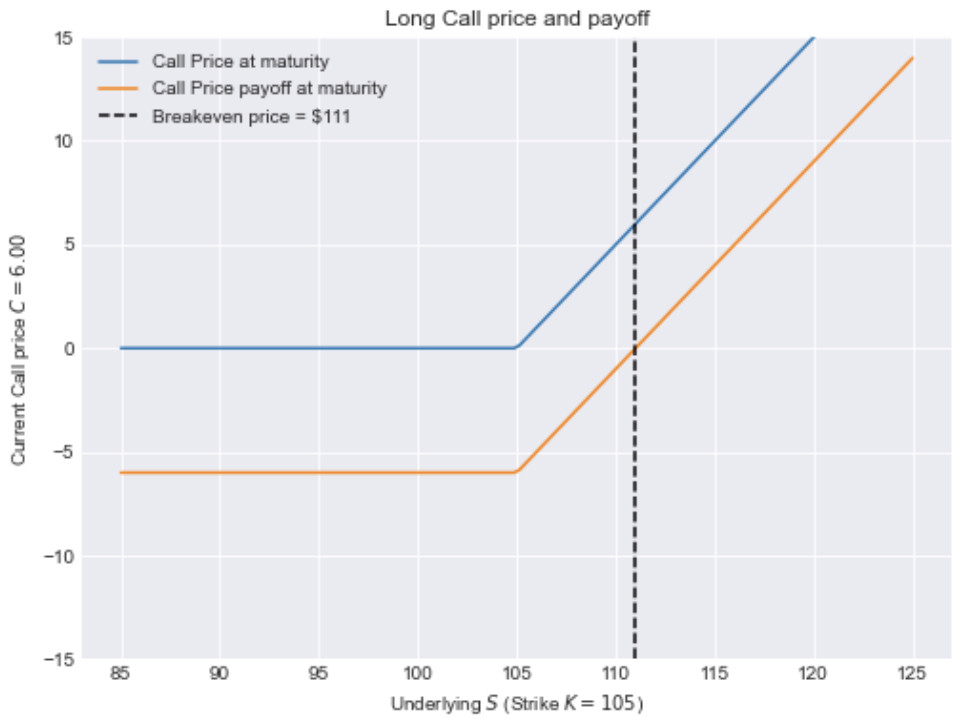
As we can see, as soon as the underlying price becomes larger than the breakeven price ($\$111$), the Option is profitable for the option buyer.
What do the payoff and profit look like for the option writer?
We have a specular situation. Whenever there's a profit for the option buyer, this corresponds to a loss for the option writer. That is, the payoff/profit for a Short Call position is the following:
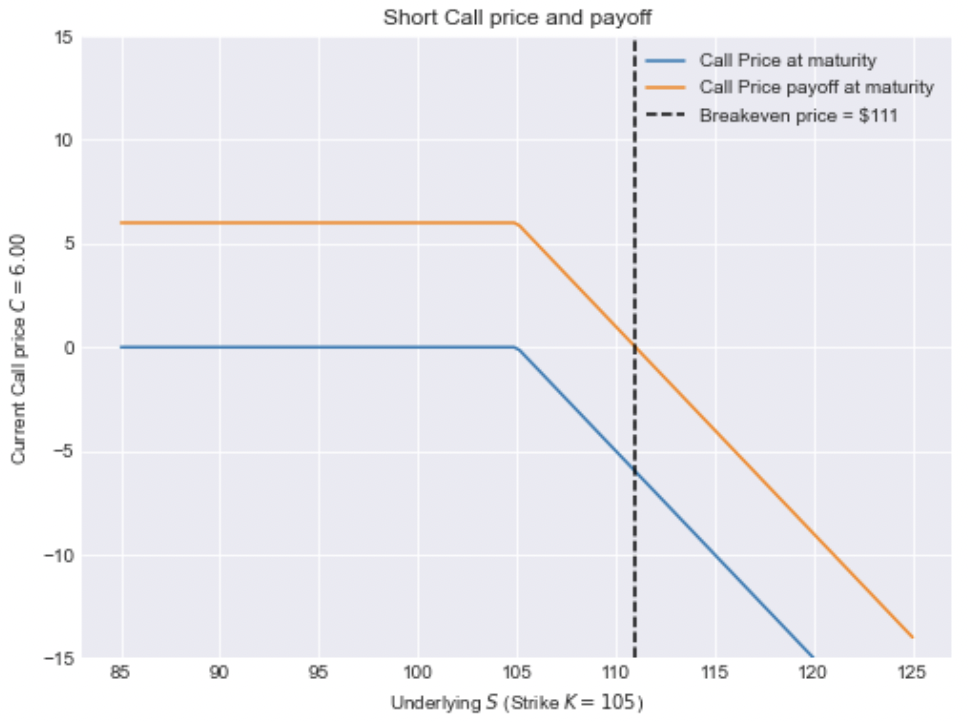
Note that in case of Call option, the option buyer has a limited loss (the option price paid) but a potential illimited profit as far the underlying price increases. On the other hand, the Call option writer has a limited profit (the same option price received) but a potential illimited loss.
Put options
Similarly to the Call option, the word right in the definition of a Put emphasishes that the holder of the option will exercise the option only if this leads to a profit. In case of a Put, the holder has the right to sell the underlying.
If this happens, then the option writer have the obligation to buy the underlying at the agreed strike price.
The same analysis we have done for the Call option can be done for the Put option with the only difference that now the option will be profitable as far as the underlying price decreases.
Put option payoff
The payoff of a Put option depends on the difference between $S_T$ and $K$ in this way: $$ \text{Put Payoff} = \max(K - S_T, 0). $$
Put option profit
Given that buying the option is not free, but the buyer has to paid the Put price $P$, we have that the profit of a Put option at maturity is given by: $$ \text{Put profit} = \text{Put payoff} - \text{Put price} = \max(K - S_T, 0) - P. $$
Put option breakeven
Therefore, what is the underlying price from which the Put option becomes profitable? Again, this is called the breakeven price, and this is the underlying price that gives a profit equal to 0: $$ \text{Put profit} = \max(K - S_T, 0) - P = 0 \quad \Longrightarrow \quad S_T = K - P. $$ This is because, an underlying price equals to $K-P$ will let the buyer recover at least what it has paid ($P$) to buying the Option. Hence, for any price less than $K-P$ the option buyer can exercise the option and get a profit.
Put payoff and profit diagram
Let us see with a plot what the Put payoff and profit look like. Consider the same data used for the Call option beforehand.
The current underlying price is $S_0 = \$100$. The Put option on this underlying, with a strike equal to $K=\$105$, is currently trading at $C = \$10.48$ (the option expires in 6 months although is not really relevant right now).
The breakeven price in this case is equals to $K-P=105 - 10.48 = \$94.52$. Then, the payoff and profit at maturity for a Long Put position is the following:
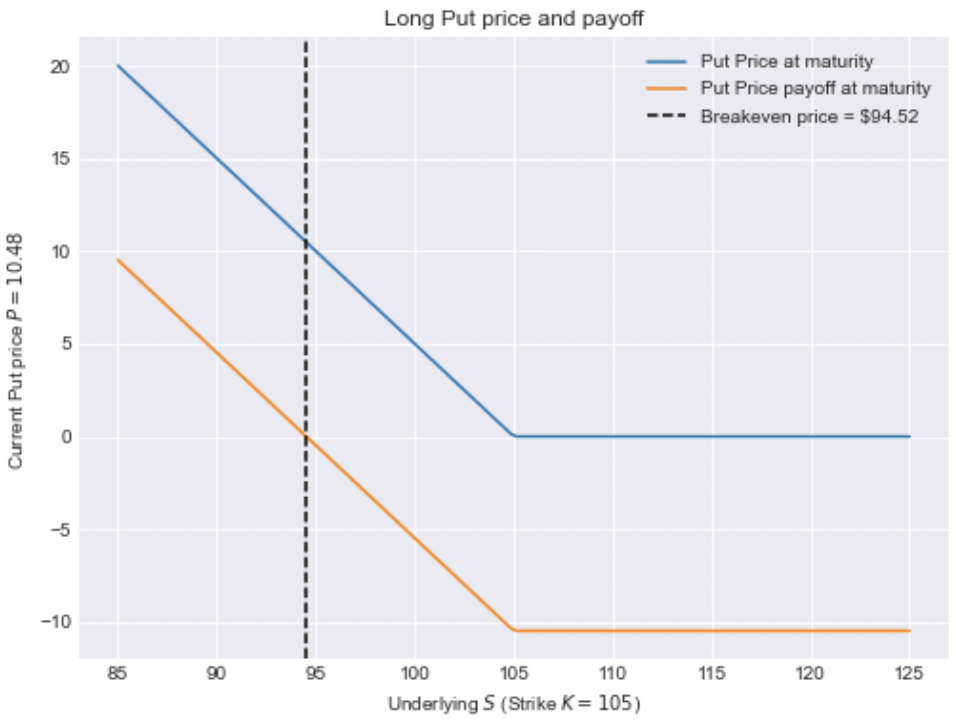
As we can see, as soon as the underlying price becomes smaller than the breakeven price ($\$94.52$), the Option is profitable for the option buyer.
For the option writer we have a specular situation. The payoff/profit for a Short Put position is the following:
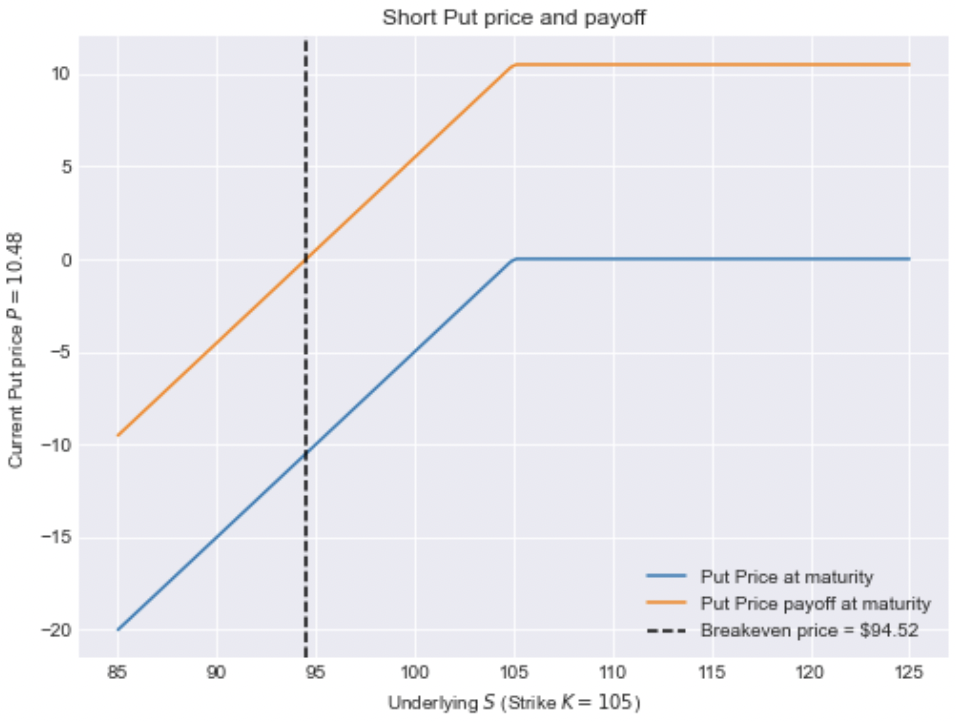
Likewise for the Call option, note that in case of a Put option, the option buyer has a limited loss (the option price paid) but a potential illimited profit as far the underlying price decreases. On the other hand, the Put option writer has a limited profit (the same option price received) but a potential illimited loss.
Intrinsic Value and Time Value
To conclude this post, we describe the concept of option moneyness. The moneyness of an option is a further characteristic useful to distinguish options.
In particular, we can distinguish options based on the 'payoff' obtained by simply looking at the underlying price $S$ and the strike price $K$. This classification derives from the so called intrinsic value and the time value of an option.
Any option price, can be explicitly seen as composed of the:
- Intrinsic value: this represent the supposed option payoff if the option could be exercised immediately. That is, for a Call option we have $\max(S - K, 0)$, whereas for a Put option this is $\max(K - S, 0)$, where $S$ is the current underlying price.
- Time value: this is the residual part of the option price due to time left to maturity.
Call example
For example, consider a Call option with maturity in 3 months and with strike price $K=\$100$.
-
Suppose that the underlying level is currently $S=\$110.5$ and that the Call is trading at $\$13.06$.
We have that the option price $C=\$13.06$ is obtained by the intrinsic value of the option, that is, $\max(S-K,0)=\max(110.5 - 100, 0) = \$10.5$ and a time value of $\$2.56$.
-
Suppose that the underlying level is currently $S=\$94.25$ and that the Call is trading at $\$3.46$.
We have that the option price $C=\$3.46$ is entirely obtained by a time value of $3.46$ since the intrinsic value is zero ($\max(S-K,0)=\max(94.25 - 100, 0) = 0$).
Put example
Now, consider a Put option with maturity in 3 months and with strike price $K=\$100$.
-
Suppose that the underlying level is currently $S=\$89.5$ and that the Call is trading at $\$12.19$.
We have that the option price $P=\$12.19$ is obtained by the intrinsic value of the option, that is, $\max(K-S,0)=\max(100 - 89.5, 0) = \$10.5$ and a time value of $\$1.69$.
-
Suppose that the underlying level is currently $S=\$108.92$ and that the Put is trading at $\$2.69$.
We have that the option price $C=\$2.69$ is entirely obtained by a time value of $2.69$ since the intrinsic value is zero ($\max(K-S,0)=\max(100 - 108.92, 0) = 0$).
Moneyness
From these examples, we get the following option classification:
-
In-The-Money (ITM): an ITM option is an option with a non-zero intrinsic value. That is, as in the cases '1.' of previous Call and Put examples. The option price comprises both the intrinsic and the time values.
More in general, a Call option is ITM if $K < S$. Conversely, a Put option is ITM if $K > S$.
-
Out-of-The-Money (OTM): an OTM option is an option with a zero intrinsic value. That is, as in the cases '2.' of previous Call and Put examples. The option price comprises the time value only.
More in general, a Call option is ITM if $K > S$. Conversely, a Put option is OTM if $K < S$.
-
At-The-Money (ITM): an ATM option in which $S\approx K$. In this case, the intrinsic value is likely to be zero o very close to zero. Then, this is the case right in the middle of ITM and OTM options.
From the following plot for long Call and Put positions we can see the corresponding regions in which these options are ITM, ATM, or OTM:
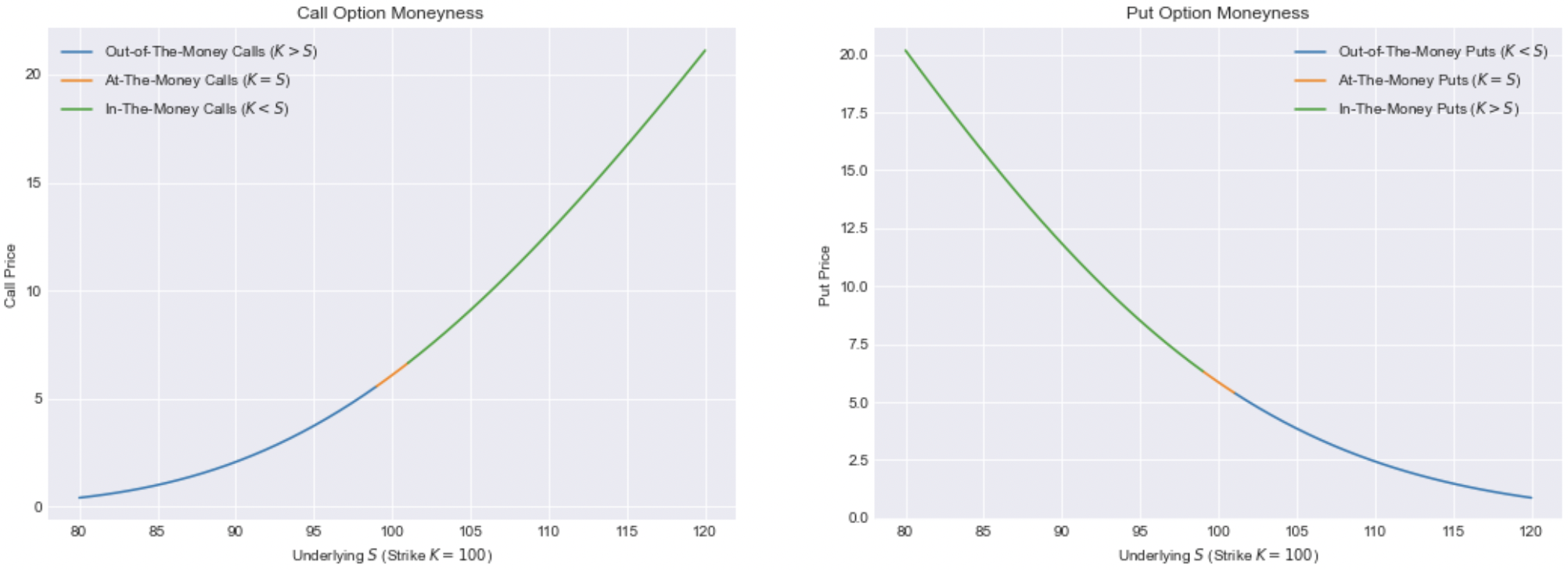
Note that due to the non-zero intrinsic value, ITM options are more expensive than OTM options.
The higher price of ITM options is due to the immediate profitability of the option. On the other hand, the lower price of OTM options is because, by buying them, we could not immediately profit from them and we should hope that with passing of time the underlying moves in the ITM region.