
Properties of Option pricing – Quant Finance
27 February 2022In this post we see a number of properties that describe the behaviour of Option prices. They do not give the exact price but they rather present important bound on the prices.
We have introduced the Options as a type of instruments called derivatives, since they derive their price from an underlying security. Have a look here for a general introduction to Call and Put options.
Given the stucture of an option contract, the option price depends on a certain number of variables. These variables certainly are the underlying price $S$, the strike price $K$, and the maturity date $T$. However, there are also other variables such as the interest rate and the volatility (of the underlying) that influence the price of an option.
The option pricing properties presented here are derived under some weak, though rationale, assumptions that generally hold in a financial market of rationale investors.
One of these assumption is the dominance:
In fact, given that security $B$ exists, if security $A$ was priced lower than security $B$, then no investor would be interesting in buying the more expensive security $B$. That is, it would have no possibility to exists.
Basic option pricing properties
So far, let us suppose that the only variables affecting the price of an option are the underlying price $S$, the strike price $K$, and the time-to-expiration $t$.
Call options
We start by talking about Call options. Let us denote by $C$ the price of a European Call option. We have that: $$ C = C(S, K, t). $$
A first, though obvious, property is that an option is a limited liability instrument, meaning that its price cannot be less than zero.
On expiration, the call option buyer has the right to buy the underlying at the strike price $K$. This right will be exercised only if the underlying price $S$ will be greater than the strike $K$. Otherwise, the call should expire without being exercised, i.e., worthless.
This is the Call payoff at maturity or, more generally, the Intrinsic Value.
A Call option will be worth its intrinsic value only at maturity and during the life of the option, its corresponding price, will be always greater than or equal to the Intrinsic Value.
Suppose that at maturity we have $S=\$54$, $K=\$50$ and the Call price $C=\$3$. This price is less than its current Intrinsic Value $\max(S-K,0)=\max(54-50,0)=\$4$. Therefore, we could buy the option by paying $\$3$, and then exercising it. Thus, we buy the underlying at a strike price of $\$50$ and immediately we will sold it at its current market price, i.e., $\$54$. The total profit from this operation is: $-3 + (-50 + 54) = \$1$.
What about the time-to-maturity? An option with a longer time-to-maturity has all the characteristics of an equivalent option with a shorter time-to-maturity. However, once the shorter term option has expired, the longer term one can be still exercised. It has then be priced something more than the shorter term option.
This property means that the Call option price is an increasing function of the time-to-maturity.
The four properties we have seen so far can be better summarized by the following plot:
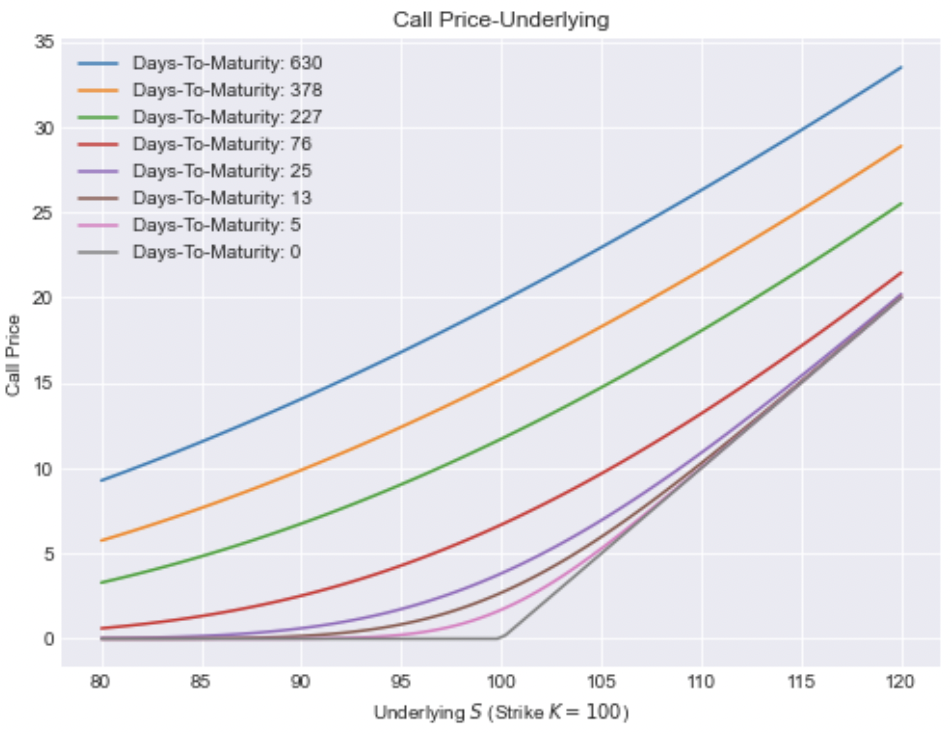
This is the evolution of the Call price until the expiration date. Prices are always positive and larger than the payoff at maturity (last grey line). Also, options with larger time-to-maturities have prices larger than options with shorter time-to-maturities.
And what about the strike?
That is, the Call option price is a decreasing function of the strike price. The situation is something like this:
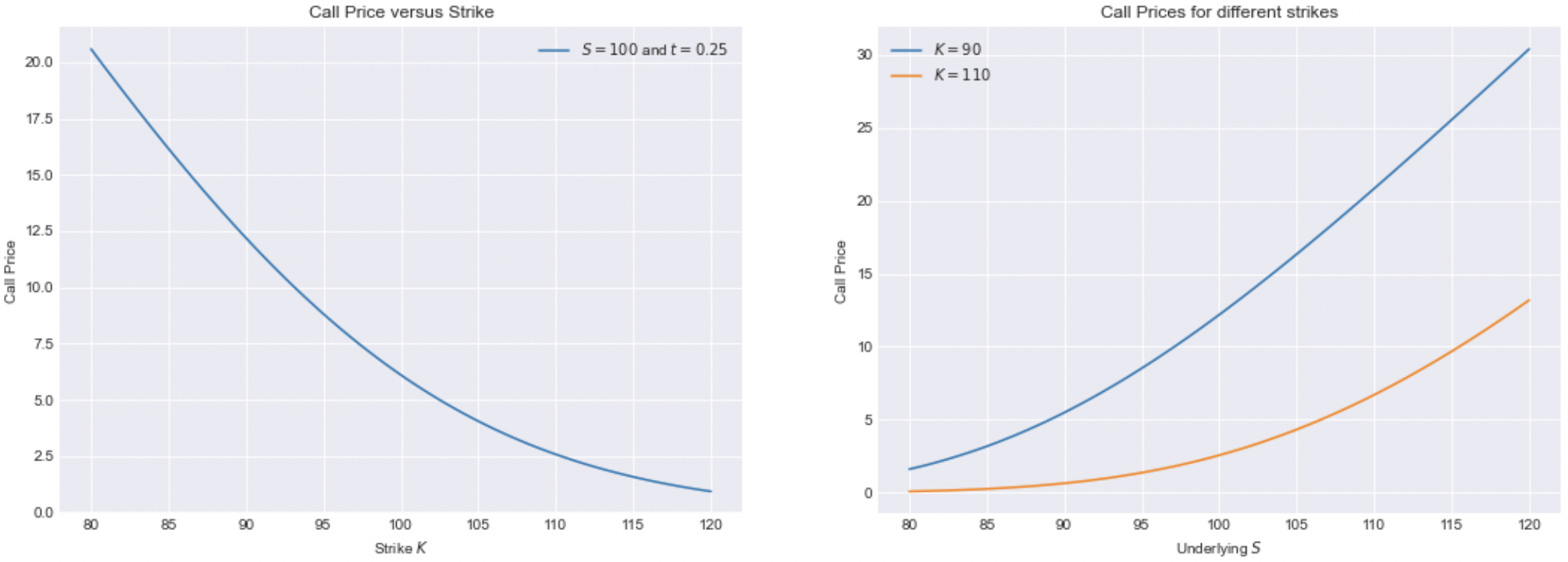
Can a Call option be worth more than the underlying, or is the underlying price an upper bound for the option price?
In principle, one can consider the underlying as a security that can be 'converted' into itself at any time and for no cost, i.e., the underlying can be see as an option with no expiration and with zero strike price.
From Property 4 and 5 we have seen that a lower strike price and a larger time-to-maturity increase the option price. That is, any option with a strike price larger than zero and a limited time-to-maturity will be worth less than the underlying. These restrictions guaranteed that owning the option is not more valuable than owning the underlying outright.
The case $S = C(S, K, T)$ will be possible only for $K=0$ and $T=\infty$. In such case, the price would be then the straight line $C=S$ in the option-underlying plane. On the other hand, the lower bound is the payoff we have seen before:
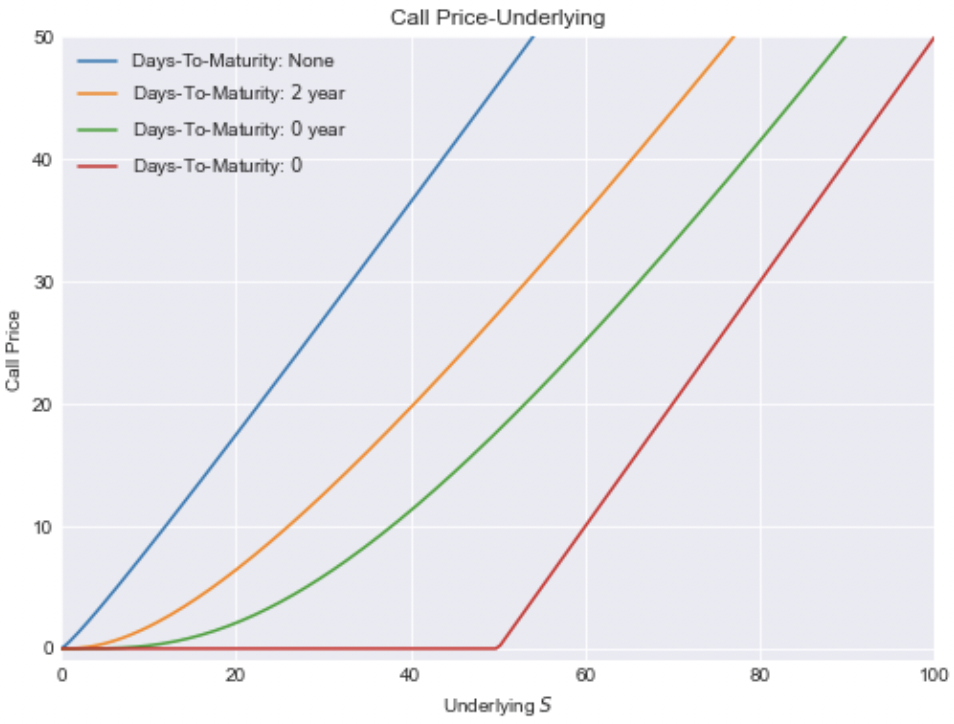
An option, in general, is a leveraged security. This means that for an investment which is less than the underlying price, an investor can profit from the complete movement of the underlying. In particular, the Call option price will change in percentage terms more than the underlying price.
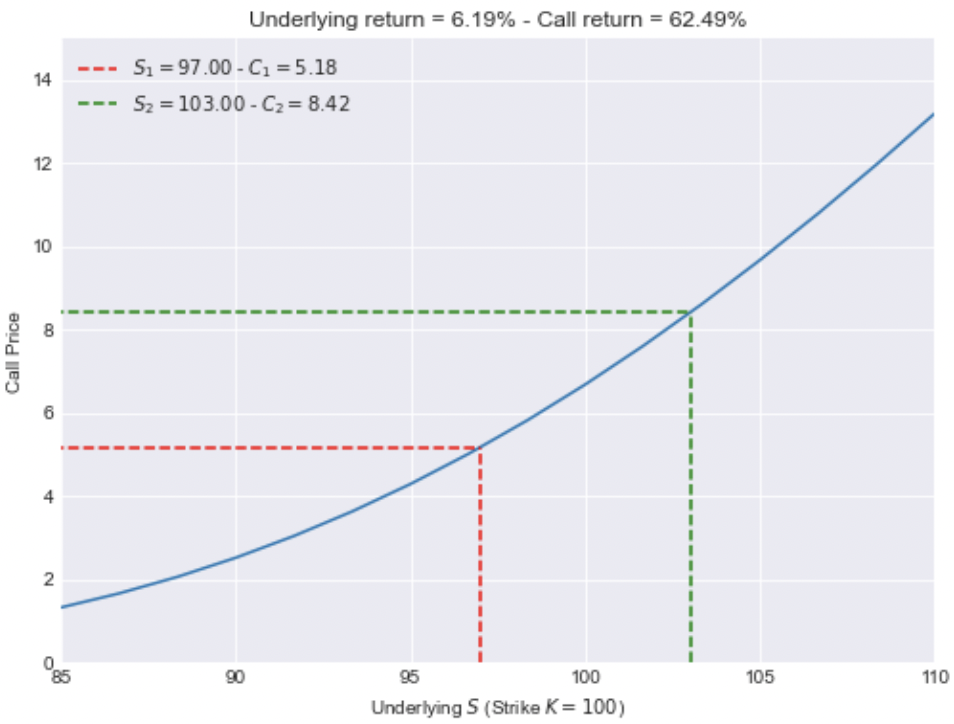
If the underlying has a return of about $6\%$ (since it passes from $\$97$ to $\$103$), the call price has a return of about $62\%$ (since it moves from $\$5.18$ to $\$8.42$)! However, note that the new underlying price is still not enough for the call to be profitable: the new price $\$103$ is still less than the breakeven price $K+C=100+5.18=105.18$, see here.
So far we have not talked about interest rates. Interest rates are important and are generally positively correlated with stock prices.
The argument for this can be that if, for example, a saving account yields $3\%$ and the same $3\%$ can be earned from investing in a stock, then an investor is likely to prefer the saving account. In fact, this has much less uncertainty in the final outcome. Therefore, we can conclude that a stock return should be at least as high as the return from a savings account.
An increase in interest rates means that we should expect the stock returns to increase and then they have a positive relation with Call options.
However, which interest rate? Generally, a government bond's interest rate is considered, or more in general, a so called risk-free rate, $r$.
The interest rate can also be used to derive further bounds on the Call prices. We have previously seen in Property 3 that the Call price is larger than $\max(S_t - K, 0)$ for every $t$.
Indeed, at time $t$, the strike price $K$ is 'worth' something smaller (concept of time-value of money). This is $Ke^{-rt}$. Hence:
Finally, what about the (underlying) volatility?
As volatility increases, the chance that the stock will do very well or very poorly increases. The owner of a Call benefits from price increases but has limited downside risk in the event of price decreases since the most the he can loose is the option price. (Similarly, a Put holder benefits from price decreases, but has limited downside risk in the event that prices increase).
Put-Call parity
All properties we have seen so far also hold for Put options in a similar way. To conclude the post we rather want to describe an important property which links the price of a Put option with the price of a Call option.
Consider a Call and a Put option with same strike $K$ and maturity $T$. Both options are European and they pays no dividends.
Consider the following two portfolios:
- Portfolio A: one European Call option and a zero-coupon bond that provides a payoff equal to $K$ at time $T$.
- Portfolio B: one European Put option and one share of the underlying.
In Portfolio A, the zero-coupon bond will be worth exactly $K$ at time $T$.
Also, if the underlying $S_T$ at maturity proves to be above $K$, then the Call will be exercised since it will be worth $S_T-K$. In this circumstance, Portfolio A will be worth $K + (S_T - K) = S_T$.
On the other hand, if $S_T$ proves to be less than $K$, then the Call option will expire worthless and Portfolio A will be simply worth $K + 0 = K$.
Therefore, at maturity, Portfolio A will be worth either $S_T$ (if $S_T > K$) or $K$ (if $S_T < K$).
Now, in Portfolio B, the share will be worth $S_T$ at time $T$.
If $S_T$ proves to be below $K$, then the Put will be exercised since it will be worth $K - S_T$. In this circumstance, Portfolio B will be worth is worth $S_T + (K - S_T) = K$
On the other hand, if $S_T$ proves to be greater than $K$, then the Put expires worthless and the portfolio will be simply worth $S_T + 0 = S_T$.
Therefore, at maturity, Portfolio B will be worth either $K$ (if $S_T < K$) or $S_T$ (if $S_T > K$).
These portfolios constitute a trading strategy that will lock the same future outcome under the same circumstances. Given that their values at maturity $T$ is the same, the portfolio values must also be equal today. (This is due to the European option assumption and the lack of dividends).
Let $C$ and $P$ be the Call and the Put prices today, respectively. The underlying price today is, say $S_0$, whereas the amount $K$ at maturity is worth today $Ke^{-rt}$.
Therefore, since Portfolio A's value today is $C + Ke^{-rt}$ and Portfolio B's value today is $P + S_0$, we have derived the following Put-Call parity: $$ C + Ke^{-rt} = P + S_0. $$
This formula uniquely determines the price of a Put from the price of a Call with same strike and time-to-maturity, and vice versa.